

Why Choose Us
Global On-Site Installation and training & Local After-Sales Service & On-site Support
Local Partnership Service Available.Professional engineers available for worldwide installation, training, commissioning, and 24/7 remote technical assistance.
Customized Automation Solutions
Our engineering team works closely with customers to design and deliver tailored automation systems that fit specific manufacturing workflows - from smart factory integration to turnkey SMT line setups.
Complete Turnkey Production Line Solution
From single machines to fully integrated SMT and automation lines, we provide one-stop solutions tailored to your production needs.
Fast After-Sales Service & Spare Parts Support
Quick-response after-sales service with stable spare parts supply to minimize downtime and keep your production running smoothly.
↵
Types of SMT Reflow Oven
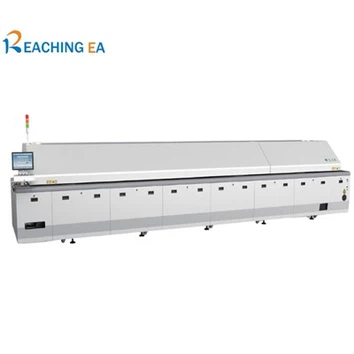
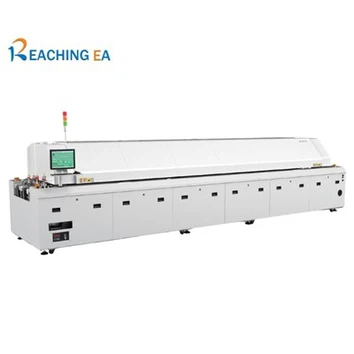
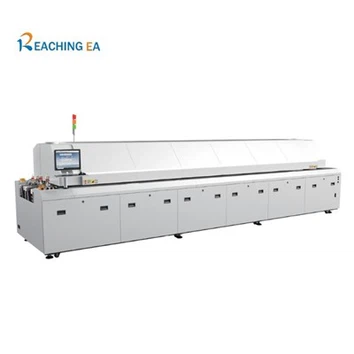
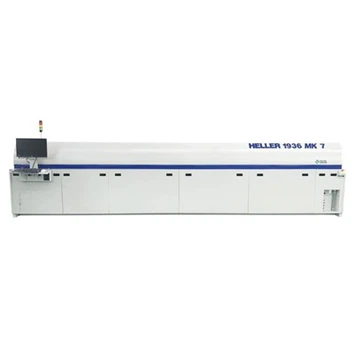
Hot Air SMT Reflow Oven
Uses high-efficiency hot air circulation to ensure uniform heating and stable soldering performance.
Features:
- Stable temperature control
- Uniform heat distribution
- Suitable for standard SMT production
- Easy operation and maintenance
Applications:
Consumer electronics, LED products, industrial PCBA, general SMT assembly.
SMT Lead-Free Reflow Oven
Designed specifically for lead-free soldering processes with higher temperature requirements and precise thermal profiling.
Features:
- Optimized for lead-free production
- Accurate temperature control
- Excellent thermal stability
- Meets modern environmental standards
Applications:
Lead-free SMT manufacturing, automotive electronics, communication equipment, industrial control boards.
Nitrogen SMT Reflow Soldering Oven
Operates in a nitrogen-protected environment to reduce oxidation and improve soldering quality.
Features:
- Reduced oxidation during soldering
- Better solder joint reliability
- Improved wetting performance
- Suitable for high-precision SMT assembly
Applications:
High-end electronics, semiconductor packaging, automotive electronics, high-reliability PCBA production.
Why Choose Our SMT Reflow Oven
1. Stable & Consistent Soldering Quality
Advanced hot air circulation system ensures uniform temperature distribution across all heating zones, delivering stable soldering results for different PCB applications.
2. Lead-Free Process Compatible
Designed for modern SMT production requirements, fully suitable for lead-free soldering processes with precise temperature profile control.
3. Nitrogen Optional
Nitrogen reflow solution available for higher soldering quality, reducing oxidation and improving solder joint reliability for demanding products.
4. Intelligent Temperature Control
High-precision PID temperature control system provides accurate heating performance and minimizes temperature deviation during production.
5. Energy Saving Design
Optimized thermal insulation structure reduces power consumption while maintaining efficient heating performance, helping customers lower operating costs.
6. User-Friendly Operation
Easy-to-use software interface with convenient parameter setting, recipe storage, and real-time monitoring for efficient operation.
7. One-Stop SMT Solution
Besides reflow ovens, we can also provide complete SMT production line solutions including:
- SMT Pick and Place Machine
- PCB Loader & Conveyor
- Solder Paste Printer
- AOI Inspection
- Wave Soldering Machine
- SMT Peripheral Equipment
Applications Industry
Our SMT Reflow Oven is widely used in various electronics manufacturing industries, including:
● Consumer Electronics
Mobile phones, tablets, smart devices, TV boards, home appliances
● LED Industry
LED lighting, LED drivers, display modules
● Automotive Electronics
Automotive control boards, sensors, car lighting systems
● Industrial Electronics
Industrial control systems, automation equipment, power modules
● Communication Industry
Routers, communication modules, networking equipment
● Medical Electronics
Medical control boards, monitoring devices, testing equipment
● Computer & IT Products
Motherboards, graphic cards, computer peripherals
● New Energy Industry
Solar energy controllers, battery management systems, charging equipment
● Security & Surveillance
CCTV boards, alarm systems, access control devices
● Aerospace & Military Electronics
High-reliability electronic assemblies and precision PCB applications
SMT Reflow Oven Working Principle
The SMT reflow oven works by heating the PCB assembly through controlled temperature zones to melt solder paste and permanently solder electronic components onto the PCB surface.
Main Working Process
1. Solder Paste Printing
Solder paste is first printed onto the PCB pads using a stencil printer.
2. Component Placement
SMT components are mounted onto the PCB by the pick and place machine.
3. PCB Enters Reflow Oven
The PCB is transported into the reflow oven through the conveyor system.
4. Preheating Zone
The PCB is gradually heated to activate the flux and reduce thermal shock to components.
5. Soaking Zone
Temperature becomes stable and uniform across the PCB, preparing the solder paste for melting.
6. Reflow Heating Zone
The temperature rises above the solder paste melting point, causing the solder paste to melt and form reliable solder joints.
7. Cooling Zone
The PCB is gradually cooled down to solidify the solder joints and complete the soldering process.
Core Heating Principle
The smt reflow oven mainly uses:
- Hot air convection heating
- Infrared assisted heating (optional in some models)
- Nitrogen protection system (optional)
The circulating hot air transfers heat evenly to the PCB and components, ensuring stable soldering quality.
Advantages of SMT Reflow Soldering
- High soldering consistency
- Suitable for lead-free process
- High automation efficiency
- Low defect rate
- Supports mass production
- Suitable for fine-pitch components and complex PCB assemblies
Typical Temperature Profile
A standard SMT reflow temperature profile usually includes:
- Preheat Stage
- Soak Stage
- Reflow Stage
- Cooling Stage
Different solder pastes and PCB products require different temperature settings.
How to Choose a SMT Reflow Oven
Choosing the right smt reflow oven is essential for achieving stable soldering quality, production efficiency, and long-term manufacturing reliability.
1. Production Capacity
Choose the oven configuration based on your daily production volume and PCB size.
- Small batch production → Compact or fewer heating zones
- Medium to large production → Inline multi-zone reflow oven
2. Lead-Free or Leaded Process
Lead-free soldering requires higher and more precise temperature control.
- Standard production → Hot Air Reflow Oven
- Lead-free SMT production → SMT Lead-Free Reflow Oven
3. Product Complexity
Complex PCB assemblies and fine-pitch components require better thermal stability and reduced oxidation.
- Standard electronics → Hot Air Reflow Oven
- High-precision or sensitive components → Nitrogen Reflow Soldering Oven
4. Temperature Control Accuracy
A stable thermal profile is critical for soldering consistency and product reliability.
Important factors include:
- Heating zone quantity
- Temperature uniformity
- Conveyor stability
- Cooling efficiency
5. Nitrogen Requirement
Nitrogen protection helps improve solder joint quality and reduce oxidation during soldering.
Recommended for:
- Automotive electronics
- Semiconductor packaging
- High-reliability PCBA
- Fine-pitch components
Case Show
Full LED Production Line

FAQ – Reflow Oven
Q: 1. What is a smt reflow oven used for?
A: A reflow oven is used in SMT production to melt solder paste and permanently solder electronic components onto PCB boards.
Q: 2. What is the difference between hot air and nitrogen reflow ovens?
A: Hot air reflow ovens use heated air for soldering, while nitrogen reflow ovens use a nitrogen environment to reduce oxidation and improve solder joint quality.
Q: 3. Is a nitrogen reflow oven necessary?
A: Nitrogen reflow is recommended for high-precision products, fine-pitch components, automotive electronics, and high-reliability PCBA production.
Q: 4. What is a lead-free reflow oven?
A: A lead-free reflow oven is designed for lead-free soldering processes that require higher temperatures and more precise thermal control.
Q: 5. How many heating zones do I need?
A: The required heating zones depend on your PCB complexity and production requirements.
Common configurations include 6, 8, 10, and 12 zones.
Q: 6. How do I choose the right reflow oven?
A: You should consider:
- Production capacity
- PCB size and complexity
- Lead-free requirements
- Nitrogen requirements
- Factory space and budget
Q: 7. What temperature is used in reflow soldering?
A: Typical reflow soldering temperatures range from 220°C to 260°C depending on the solder paste and production process.
Q: 8. Can the smt reflow oven support different PCB sizes?
A: Yes. Most reflow ovens support adjustable conveyor width for different PCB dimensions.
Q: 9. Do you provide installation and technical support?
A: Yes. We provide global on-site installation, remote technical support, operator training, and after-sales service.
Q: 10. Are spare parts available?
A: Yes. We provide long-term spare parts support and maintenance service to ensure stable machine operation.
We're well-known as one of the leading smt reflow oven manufacturers and suppliers in China. Please feel free to buy high quality smt reflow oven made in China here from our factory. For price consultation, contact us.
heller vacuum reflow oven, Lead Free Reflow Oven for Consumer Electronics, Nitrogen Atmosphere Reflow Oven