

Introduction
Building a reliable surface-mount technology (SMT) line starts with one decision that shapes everything downstream: the SMT pick and place machine. This is the equipment that sets tiny resistors, capacitors, ICs, and connectors onto a printed circuit board at speeds measured in tens of thousands of components per hour. Get the choice wrong and you live with bottlenecks, scrap, and rework for years. At Reaching Electronic Assembly (Reaching EA), we have supplied SMT lines to factories across consumer electronics, automotive, and industrial control, and the same questions come up every time a buyer sits down to specify a new line.
This guide walks through the six specifications that actually matter when you choose an SMT pick and place machine, the mistakes we see most often, and the trade-offs between speed, accuracy, and total cost of ownership.
The SMT Line Around the Pick and Place Machine
To choose a placer well, it helps to see where it sits in the full SMT line. The process begins at the solder paste printer, where a stencil deposits paste onto pads. Boards then travel on conveyors to the SMT pick and place machine, which mounts every component. From there the board enters the reflow oven, where heat profiles the solder and forms joints. After cooling, automated optical inspection (AOI) checks for missing, shifted, or tombstoned parts, and selective or wave soldering handles any through-hole components. Conformal coating and X-ray inspection close out the line for harsh-environment or high-reliability products.
The placer is the most flexible and most expensive node in that chain, which is exactly why its specification deserves the most attention. A line is only as fast as its slowest, least capable station, and the placement machine sets the tempo for everything before and after it.
Why the Right SMT Pick and Place Machine Matters
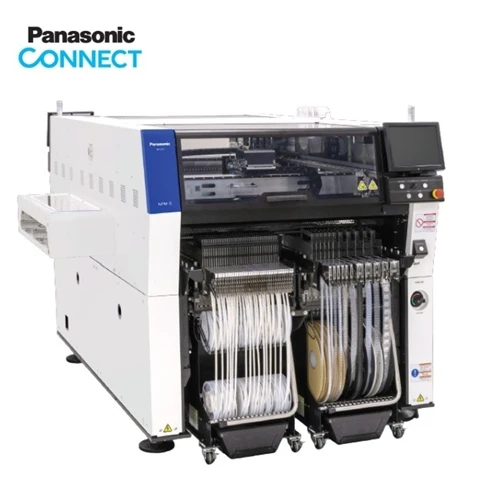
A pick and place machine is the heart of the SMT line. Upstream of it sit the solder paste printer and stencil; downstream sit reflow oven, AOI (automated optical inspection), and sometimes wave soldering or conformal coating. If the placer cannot keep pace or cannot place parts accurately, no amount of optimization elsewhere recovers the lost yield. Placement defects are also expensive: a misplaced 0201 capacitor may pass AOI and fail only at functional test, by which point the board has absorbed far more value-add cost.
For a new SMT line, the placement machine typically represents the largest single capital outlay. Choosing it well means matching capability to your real product mix rather than buying the highest headline speed on the brochure.
Criterion 1: Placement Speed and Real Throughput (CPH)
Speed is the first number every supplier quotes, usually as "components per hour" (CPH). A high-speed SMT pick and place machine can exceed 100,000 CPH in optimal conditions, while a flexible mid-range mounter may sit around 20,000–40,000 CPH. The trap is that nominal CPH is measured under idealized conditions - large boards, a few high-count parts, and perfect feed.
Look instead at your actual board. Count the unique components and the total placements per panel, then ask the supplier for a simulated cycle time on your design. Real-world throughput is what determines how many boards per shift you ship. When comparing two machines, always compare simulated placement time on the same Gerber and BOM, not brochure CPH. At Reaching EA we run this simulation as part of line sizing: we load your centroid file and BOM, assign nozzles and feeders, and report a realistic boards-per-hour number you can plan capacity around.
Criterion 2: Placement Accuracy and Process Capability (CPK)
Accuracy is quoted in microns, often ±25–50 μm at a specified confidence. But the number that matters for production is CPK (process capability index). A machine may be accurate in a lab yet drift across an eight-hour shift as feeders and fiducials vary. For fine-pitch QFP, QFN, and 01005 parts, insist on a documented CPK of 1.33 or higher on the parts you actually run.
Accuracy and speed trade off: pushing a flexible SMT pick and place machine to its top CPH usually relaxes its placement capability. Decide which boards need the tightest tolerance and validate the machine on those, not on a trivial test board.
Criterion 3: Board Size and Feeder Capacity
Your maximum board dimensions decide the machine envelope. A line built for phone mainboards will not accept a 1.2-meter LED panel without a different placer or a conveyor extension. Equally important is feeder capacity - the number of component types the machine can hold at once.
High-mix, low-volume factories live or die by feeder count. If you must swap reels between every job, changeover time erodes the speed you paid for. A good SMT pick and place machine for high-mix work carries 100+ feeders and supports quick-change stacks so operators reload without stopping the line.
Criterion 4: Component Range and Placement Flexibility
Component flexibility answers one question: can this machine place everything on my board? That includes the obvious passive sizes (0201, 0402, 0603), fine-pitch ICs down to 0.3 mm pitch, connectors, and odd-forms such as transformers or shielded inductors. Some flexible mounters add a dedicated head or nozzle bank for odd-form parts so you avoid a manual placement station.
If your roadmap includes newer packages - wafer-level CSP, PoP, or bottom-termination components - confirm the machine's vision system and nozzle library support them now, not "in a future firmware."
Criterion 5: Programming, Software, and Changeover
The hidden cost of any SMT pick and place machine is the time engineers spend teaching it a new board. Modern lines import Gerber, centroid (pick-and-place) files, and BOM directly, then auto-generate placement programs. The best software flags missing footprints, suggests nozzle assignments, and lets you simulate the run before a single board moves.
Offline programming matters for high-mix shops: prepare the next job on a separate station while the current board runs. When you evaluate software, ask whether program transfer, feeder setup sheets, and verification reports are included or sold as add-ons.
Criterion 6: Support, Spare Parts, and Total Cost of Ownership
Purchase price is maybe half the story. Nozzles, feeders, and cameras wear out; a failed feeder at 2 a.m. stops the whole line. Before you sign, map the local spare-parts stock, the response time of the service team, and the cost of a yearly maintenance contract.
A flexible SMT pick and place machine with strong local support and a deep nozzle library will cost less over five years than a cheaper box that sits idle waiting for a part from overseas. Total cost of ownership - energy, nozzles, feeders, service, downtime - is the number your finance team should see.
Top 5 Mistakes Buyers Make
- Chasing headline CPH. Nominal speed rarely matches your panel; simulate on real data.
- Ignoring feeder count. Low feeder capacity forces constant changeovers that kill throughput.
- Skipping CPK validation. Lab accuracy is not shift-long capability on fine-pitch parts.
- Under-buying odd-form support. A manual station for connectors quietly becomes your bottleneck.
- Forgetting software costs. Offline programming and reporting should be in the base quote.
FAQ
Q1: What is a good CPH for a small SMT line?
For prototyping and low-volume production, 20,000–40,000 CPH is usually enough. High-volume consumer lines often need 80,000+ CPH across multiple placement modules.
Q2: Is a flexible mounter or a high-speed mounter better?
It depends on mix. High-mix, low-volume shops benefit from a flexible SMT pick and place machine with many feeders and fast changeover, because most of their cost is in setup, not run time. Single-product, high-volume lines want dedicated high-speed modules that trade flexibility for raw CPH. Many factories run both: a flexible mounter for prototypes and a high-speed line for the steady seller.
Q3: How accurate does placement need to be for 0.4 mm QFP?
You want placement accuracy around ±30–40 μm with CPK ≥1.33 on that package. Validate on your actual board, not a test coupon.
Q4: Can one machine place both 0201 and large connectors?
Yes, with the right nozzle set and vision. Confirm the nozzle library and a dedicated odd-form head if your connectors are bulky or odd-shaped.
Q5: What standards govern placement equipment performance?
IPC-9850 defines a performance test method for surface-mount placement equipment, and IPC-A-610 sets the acceptance criteria for assembled boards. Use both when specifying and accepting a line.
Q6: How long does changeover take on a modern line?
With quick-change feeders and offline programming, changeover can drop to under 15 minutes. Without them, expect an hour or more per job.
Q7: Should I buy new or refurbished placement equipment?
Refurbished high-end machines can be excellent value if the supplier warrants feeders and nozzles and stocks spares locally. For a first line, a warranted flexible mounter with documented CPK is the safer bet than a bargain box with no support trail. Factor in whether the seller can still source the exact nozzles and feeder types your product needs two years from now.
Conclusion
Choosing an SMT pick and place machine is less about the biggest number on the spec sheet and more about matching speed, accuracy, feeder capacity, and support to your real product mix. Simulate throughput on your own boards, validate CPK on your finest pitch, and price the total cost of ownership before you commit.
Reaching Electronic Assembly (Reaching EA) supplies complete SMT lines - from solder paste printer and pick and place machine to reflow oven, AOI, and wave soldering - backed by local spare parts and programming support. Contact our team to size a line for your boards and get a simulated cycle time on your Gerber and BOM.